
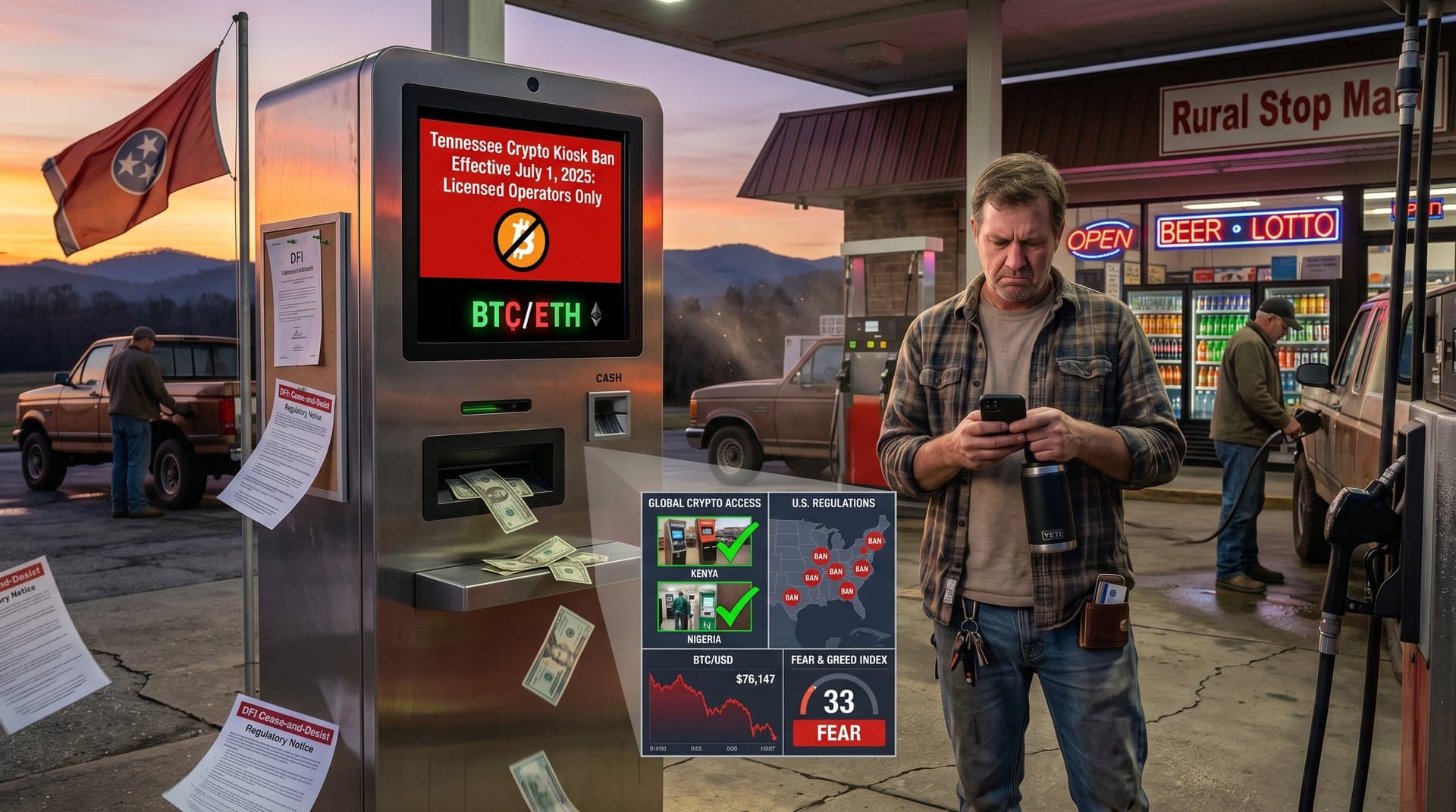
- 1. Tennessee crypto kiosk ban starts July 1, 2025, targeting unlicensed machines amid $112M FTC-reported scam losses.
- 2. 128,000 unbanked households lose cash to BTC access at $76,147, forcing shift to KYC apps.
- 3. Fear & Greed Index hits 33 as BTC drops 0.8%; global markets like Kenya's M-Pesa contrast U.S. caution.
The Tennessee crypto kiosk ban takes effect July 1, 2025. State lawmakers target unlicensed machines. These devices convert cash to Bitcoin and other cryptocurrencies. Lawmakers aim to combat rampant scams.
Regulators cite surging fraud. The Federal Trade Commission (FTC) reports crypto ATM scams hit record highs in 2023. Consumer losses topped $112 million nationwide. See FTC data.
Bitcoin trades at $76,147 USD. The price fell 0.8% over 24 hours. Ethereum stands at $2,293.42 USD, up 0.3%. The Fear & Greed Index from Alternative.me registers 33. This score indicates fear. See Alternative.me Fear & Greed Index.
- Asset: BTC · Price (USD): $76,147 · 24h Change: -0.8%
- Asset: ETH · Price (USD): $2,293.42 · 24h Change: +0.3%
- Asset: USDT · Price (USD): $1.00 · 24h Change: 0.0%
- Asset: XRP · Price (USD): $1.38 · 24h Change: -1.0%
- Asset: BNB · Price (USD): $623.32 · 24h Change: +0.1%
CoinGecko provides live price tracking. See CoinGecko.
Reasons Behind Tennessee Crypto Kiosk Ban
Crypto kiosks sit at gas stations, malls, and convenience stores. They charge fees of 15% to 30%. Scammers use fake QR codes linked to fraudulent wallets. Victims deposit cash but receive no cryptocurrency. Operators like Binance kiosks integrate Know Your Customer (KYC) protocols. Yet they face complaints.
Tennessee requires money transmitter licenses (MTL) from the Department of Financial Institutions (DFI). Unlicensed kiosks shut down after July 1. CoinDesk journalist Nikhilesh De notes growing U.S. scrutiny on these machines. See CoinDesk report.
Governor Bill Lee signed Senate Bill 2256 into law last year. The bill prioritizes consumer protection. The DFI issued 12 cease-and-desist orders to rogue operators since 2023.
Impact on Unbanked Households from Tennessee Crypto Kiosk Ban
The Federal Deposit Insurance Corporation (FDIC) 2023 survey shows key data. It reveals 4.5% of Tennessee households lack bank accounts. This equals about 128,000 unbanked households. Rural residents rely on kiosks for cash to crypto conversions. They use kiosks for remittances abroad and alternative savings.
The ban pushes users to online exchanges like Coinbase or Binance. These platforms demand ID verification and bank links. Many unbanked lack these options. This creates access barriers. See FDIC Unbanked Survey.
Fintech advocate Sarah Chen from the Consumer Financial Protection Bureau (CFPB) criticizes the ban. She argues it excludes vulnerable populations. "Kiosks bridge gaps for the unbanked," Chen stated in a recent panel.
Global Contrasts to Tennessee Crypto Kiosk Ban
Emerging markets handle kiosks differently. In Kenya, Safaricom's M-Pesa agents drive results. They achieve 80% mobile money penetration, per Central Bank of Kenya data. Users convert cash to digital wallets instantly. This fuels remittances worth 3% of GDP.
Nigeria leads Africa in crypto access. P2P agents and kiosks serve 40% of adults. Chainalysis 2024 report confirms this trend. These networks bypass banks and support DeFi amid naira volatility.
Latin America follows suit. El Salvador's Bitcoin Beach kiosks aid national BTC adoption. India's UPI-linked kiosks process $2 trillion annually. These areas focus on inclusion. They differ from Tennessee's scam restrictions.
Tennessee regulators note U.S. fraud scale. Losses hit $112 million versus Kenya's $10 million. Global firms like Binance adapt with compliant models.
Tech Innovations After Tennessee Crypto Kiosk Ban
Compliant kiosks adopt new tech. They use biometrics, facial recognition, and blockchain smart contracts. Blockchain firm Elliptic predicts 50% fee cuts from upgrades.
Binance boosts app-based on-ramps. It offers zero-fee trials for U.S. users. Markets react with caution. BTC dipped 0.8% on regulatory news. Fear & Greed at 33 shows investor wariness.
Broader Implications of Tennessee Crypto Kiosk Ban
The ban creates a precedent. New York and California watch closely. Similar bills pend there. FinCEN eyes national MTL rules.
Fintech seeks balance. It aims for secure access without exclusion. Compliant kiosks or apps redefine unbanked crypto entry. BTC stabilizes near $76,000 USD. Global finance monitors U.S. rules and their adoption impact.
Frequently Asked Questions
When does the Tennessee crypto kiosk ban start?
July 1, 2025. It halts unlicensed cash to Bitcoin kiosks to enforce money transmitter licensing.
Why does Tennessee enact crypto kiosk ban over scams?
Fees hit 30%; fake QR codes cause $112M losses per FTC 2023 data. DFI issues shutdowns.
How does Tennessee crypto kiosk ban impact unbanked access?
128,000 households lose kiosks per FDIC. Rural users shift to ID apps amid BTC at $76,147.
What are market effects of Tennessee crypto kiosk ban?
BTC drops 0.8% to $76,147. Fear & Greed Index at 33 amid U.S. regulatory fears.