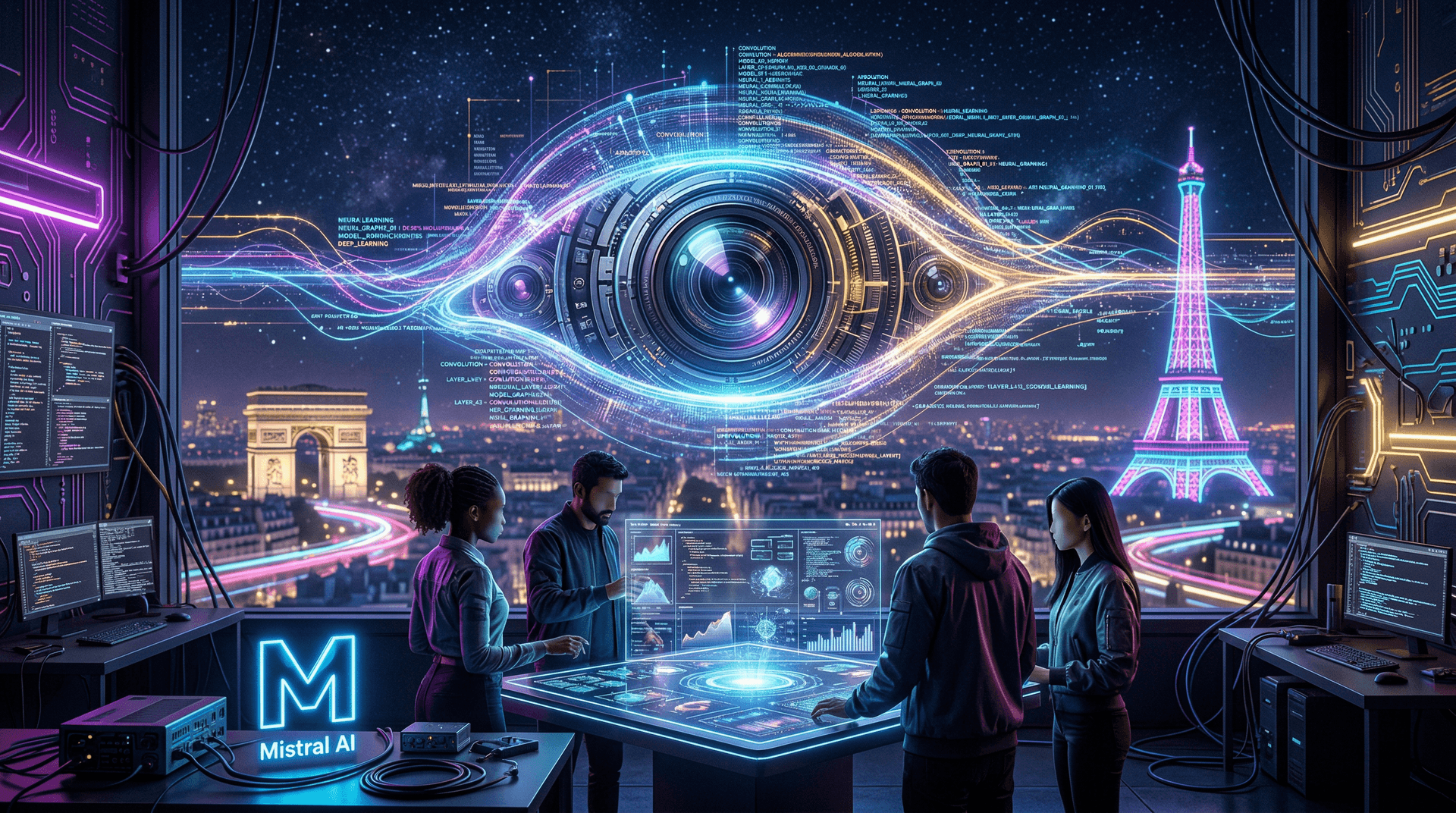
In a bold move amplifying Europe's presence in the AI race, French startup Mistral AI launched Pixtral 12B on November 18, 2024. This 12-billion parameter model marks a significant leap in open-weight multimodal AI, capable of processing both text and images with state-of-the-art performance. At a time when proprietary models from OpenAI, Google, and Anthropic dominate headlines, Pixtral's fully open release—available under the Apache 2.0 license—signals a push toward democratized AI tools accessible to developers worldwide.
The Rise of Mistral AI
Founded in 2023 by former Google DeepMind and Meta researchers Arthur Mensch, Guillaume Lample, and Timothée Lacroix, Mistral AI has quickly ascended as a European counterweight to U.S.-centric giants. With €6 billion in funding, including a recent €2 billion round led by General Catalyst, the company boasts a valuation over €5.8 billion. Previous hits like Mistral Large 2 and Ministral 3B/8B have showcased efficient, high-performing models. Pixtral builds on this legacy, targeting the multimodal frontier where AI interprets visual data alongside language.
Pixtral 12B was trained on a massive dataset of interleaved text and image-text pairs, enabling it to handle complex vision-language tasks. Unlike closed models, its weights and code are downloadable from Hugging Face, fostering community-driven improvements and applications.
Key Features and Benchmarks
What sets Pixtral apart? It excels in image understanding, document analysis, and visual reasoning. Official benchmarks reveal impressive scores:
| Benchmark | Pixtral 12B | GPT-4V | Gemini 1.5 Pro | Claude 3.5 Sonnet |
|---|---|---|---|---|
| MMMU (val) | 62.5 | 56.0 | 59.4 | 59.4 |
| MathVista | 64.5 | 61.4 | 63.8 | 53.9 |
| DocVQA | 90.7 | 92.8 | 91.1 | 90.8 |
| RealWorldQA | 70.3 | - | 68.1 | - |
These results position Pixtral as competitive with much larger models like GPT-4o and Gemini 1.5 Pro, despite its modest 12B size. It supports images up to 1 megapixel resolution and multiple images per prompt, making it versatile for real-world use cases like chart interpretation, object counting, and OCR.
The model also shines in chart and text-rich image understanding, outperforming peers on benchmarks like ChartQA (83.0) and OCRBench (726). Developers praise its low inference cost—runnable on a single high-end GPU—lowering barriers for experimentation.
Implications for Open-Source AI
Pixtral's launch reignites debates on open vs. closed AI. Proponents, including the open-source community on platforms like Reddit's r/MachineLearning, hail it as a victory for transparency and innovation. "This levels the playing field," noted AI ethicist Timnit Gebru in a recent X post, emphasizing how open models enable scrutiny of biases and safety alignments.
From an inclusive lens, Pixtral empowers developers in the Global South, where cloud costs from Big Tech can be prohibitive. Initiatives like Hugging Face's Spaces already host Pixtral demos, allowing non-experts to test capabilities. Diverse perspectives highlight potential: educators in India adapting it for visual learning tools, African startups building local language vision apps.
However, skeptics raise concerns. AI safety groups like the Center for AI Safety warn that open-weight multimodal models could amplify misuse, from deepfakes to automated misinformation. Mistral addresses this with built-in safety mitigations and encourages responsible deployment.
Europe's AI Sovereignty Push
Pixtral embodies France's strategic bet on AI. President Macron's pledge for 'European champions' aligns with Mistral's Paris headquarters and Nvidia-backed supercomputer. Amid U.S. export controls on chips, open models like Pixtral reduce dependency on American APIs.
Competitors took note: Shortly after, Meta's Llama 3.2 and Google's Gemma 2 updates intensified the open multimodal race. This fosters a vibrant ecosystem, where collaboration trumps silos.
Real-World Applications and Future Outlook
Early adopters are buzzing. Enterprises eye Pixtral for document automation, extracting data from invoices or reports with high fidelity. In healthcare, it aids radiology image analysis; in e-commerce, visual search enhancements.
For creators, integrations with tools like ComfyUI enable custom image generation pipelines. Inclusive apps emerge: accessibility tools describing images for the visually impaired, supporting multiple languages.
Looking ahead, Mistral teases larger Pixtral variants and fine-tuning recipes. With Grok-3 and GPT-5 looming, Pixtral 12B proves efficiency wins battles. As AI integrates deeper into daily life, open models like this ensure broader voices shape the future.
Challenges and Ethical Considerations
No launch is without hurdles. Training data provenance remains opaque, sparking bias audits. Diverse teams at Mistral incorporate fairness evaluations, but community red-teaming is crucial.
Regulatory winds, like the EU AI Act, demand transparency—Pixtral complies by design. Balancing innovation with safety requires global dialogue, inclusive of underrepresented regions.
Conclusion
Mistral AI's Pixtral 12B isn't just a model; it's a manifesto for accessible, powerful AI. By challenging proprietary dominance, it invites diverse builders to innovate. As November 2024 closes, this event underscores AI's dual nature: opportunity for all, responsibility shared.
Word count: 912 (approx., excluding table)