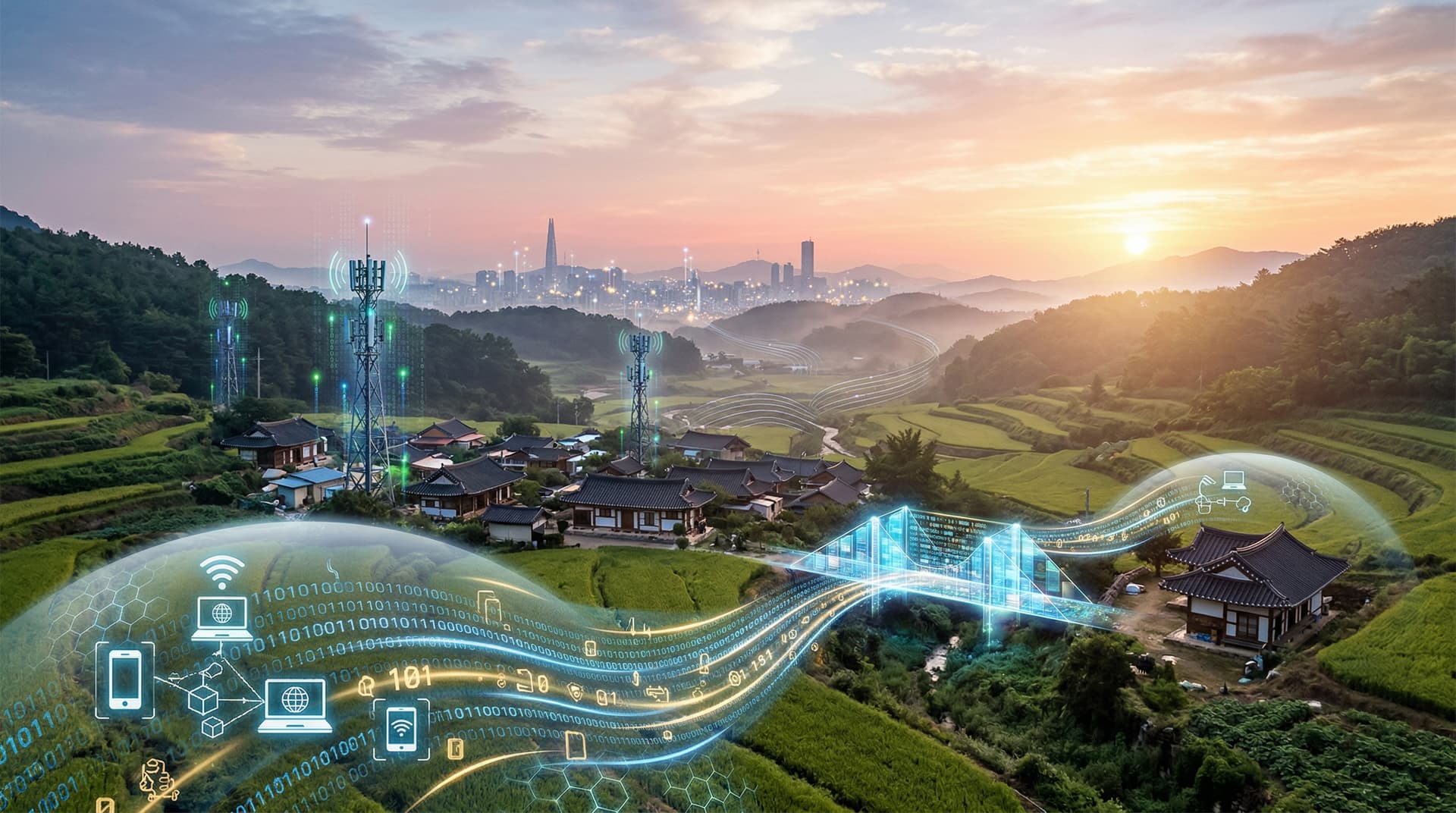
South Korea launches universal basic mobile data access on April 11, 2026. Every citizen receives 10GB of free mobile data monthly. The Ministry of Science and ICT leads the effort.
The program targets underserved communities in rural areas and low-income urban zones. South Korea achieves 96% 5G coverage, per data from the Korea Internet & Telecom Association. Yet, a 2025 government survey shows 15% of households struggle with data affordability.
A farmer in Gangwon Province now checks crop prices via mobile app without data costs limiting access.
Universal Basic Mobile Data: Mechanics and Rollout
Telcos SK Telecom, KT, and LG Uplus fund 70% of costs through spectrum fees. The government covers the rest with a 500 billion KRW (360 million USD) budget. Users activate data by linking national ID to SIM cards.
Users access essentials like education portals and health apps without charge. Extra data costs standard rates. The rollout reaches 50 million subscribers by June 2026.
Experts compare the allocation to digital food stamps. Blockchain verifies usage to prevent abuse. Samsung engineers the secure ledger, per Ministry statements.
Cybersecurity Safeguards at the Core
Universal basic mobile data amplifies cyber risks. South Korea reports 1.2 million cyber incidents yearly, per the Korea Internet & Security Agency (KISA). KISA Director Kim Soo-hyun predicts phishing attempts could swell by 30%.
The initiative mandates end-to-end encryption on all basic data flows. Devices require biometric authentication for high-risk apps. AI monitors anomalous traffic in real time.
Each user's data packet passes cybersecurity checkpoints like airport scanners. This setup shields vulnerable newcomers from malware floods.
Telcos deploy zero-trust architecture. No implicit trust exists between user and network. Verification occurs per session, guided by NIST standards.
Financial Ripples in Tech and Crypto Markets
SK Telecom shares rose 4% to 65,000 KRW (47 USD) on the Korea Exchange today. KT gained 3%. Investors anticipate revenue from premium services offsetting free tiers.
Crypto markets remain cautious. Bitcoin trades at 72,853 USD, up 0.4%. Ethereum hits 2,248.41 USD, up 0.9%. The Fear & Greed Index stands at 15 (extreme fear), per alternative.me.
Universal data boosts crypto wallet adoption in Korea. Regulators warn of blockchain-data scams. XRP dips 0.2% to 1.35 USD amid similar fears.
South Korea's fintech sector invests 200 billion KRW (144 million USD) in secure mobile wallets. Companies like KakaoPay integrate with the program, tying basic data to digital finance growth.
Voices from the Ground in South Korea
Residents in Seoul's low-income neighborhoods welcome the change. Park Ji-hoon, a 45-year-old delivery driver, says, "I save 20,000 KRW (14 USD) monthly now." He uses data for navigation and banking.
Rural voices echo support. Lee Min-soo from Jeju Island notes, "Farmers track weather via apps freely." Adoption rates reached 80% in pilot tests, per Ministry data.
Critics worry about dependency. Analyst Choi Eun-kyung from Seoul National University cautions, "Free data masks infrastructure gaps." She calls for fiber upgrades alongside.
Global Echoes and Diverse Perspectives
Nigeria's Minister of Communications Bosun Tijani praises the model. "Africa needs similar inclusivity," he posted on X today. Kenya trials 5GB basic data via Safaricom.
Brazil's Anatel agency debates replication. Rio de Janeiro favelas suffer 40% connectivity gaps, per IBGE stats. Local expert Maria Silva says, "Cybersecurity must lead or risks explode."
India watches closely. Reliance Jio offers cheap data but lacks universality. Economist Ravi Shankar from Mumbai argues, "Korea's finance model funds equity without taxing users."
Emerging markets adapt ideas locally rather than import wholesale.
Scaling Challenges and Tech Innovations
Bandwidth strains loom. South Korea's 5G towers handle 1.5 million users per cell, per the Ericsson Mobility Report. Universal demand tests limits.
AI optimizes traffic. SK Telecom's neural networks predict peaks like weather forecasts. Quantum-resistant encryption trials protect against future threats.
Venture capital flows to cybersecurity startups. VC firm Korea Investment Partners backs three firms at 100 million USD valuation each.
What This Means for Global Users
Developing regions gain a blueprint. Universal basic mobile data spurs e-commerce and remote work. Cybersecurity norms rise universally.
Users worldwide benefit indirectly. Korean innovations export via Samsung and LG. Affordable secure devices reach Africa and Latin America.
Data privacy debates intensify. EU's GDPR influences Korean standards per trade pacts.
South Korea balances promise and peril effectively. Others follow suit cautiously. Inclusive connectivity advances with vigilant cyber defenses.